A camera can record a break-in perfectly and still leave a property manager dealing with damaged doors, stolen equipment, and frustrated tenants the next morning. That is the real decision behind security cameras vs patrol officers: not which option looks more advanced, but which one reduces risk at the moment it matters.
For Houston-area businesses, communities, construction sites, and event operators, the right answer often depends on the property’s hours, layout, history of incidents, and the level of response required. Cameras provide documentation and broad visibility. Patrol officers add a trained human presence that can identify concerns, intervene within their authority, and report what happened in real time.
Security Cameras vs Patrol Officers: The Core Difference
Security cameras are tools for observation. They can watch entrances, parking areas, loading zones, hallways, and other defined locations around the clock. Depending on the system, footage may be recorded locally, stored in the cloud, or reviewed through remote monitoring. Their greatest strength is consistent visibility in the areas they can see.
Patrol officers are active security personnel. A trained officer can inspect doors and gates, check vacant areas, identify suspicious activity, enforce site procedures, assist authorized visitors, document incidents, and contact law enforcement or emergency services when needed. Their presence is not limited to a camera angle or a motion alert.
Neither option is automatically better for every property. A small office with limited after-hours traffic may benefit from cameras and controlled access. A large apartment community experiencing vehicle burglaries or trespassing may need visible mobile patrols, especially during high-risk hours. The question is whether you need evidence after an event, active deterrence before it occurs, or both.
Deterrence: Visibility Changes Behavior
Cameras can deter opportunistic crime when they are clearly visible, properly placed, and backed by working recording equipment. A person who sees signage and cameras at an entrance may think twice before trying a door or entering a restricted area. However, experienced offenders may recognize when cameras are poorly maintained, positioned too high, obstructed by lighting, or unable to capture identifying details.
A marked patrol vehicle or uniformed officer creates a different level of uncertainty. Potential offenders do not know when an officer will make the next round, where the officer may be positioned, or whether suspicious behavior will be addressed immediately. This is especially valuable for parking lots, retail centers, multifamily properties, construction sites, and facilities with multiple access points.
Visible patrols also reassure the people who belong on the property. Employees leaving late, residents walking to their vehicles, vendors making deliveries, and event guests can see that security is present and attentive. That reassurance can improve compliance with property rules and reduce the feeling that no one is watching.
Response Time Is the Major Divide
A standard camera system does not respond on its own. It records. If an incident occurs at 2:00 a.m., someone must receive an alert, review the footage, determine whether the activity is a real concern, and decide what to do next. Without live monitoring or an established response plan, footage may not be reviewed until hours later.
Even monitored camera systems have practical limits. A remote operator can observe, communicate through a speaker in some setups, and notify local authorities or a designated contact. That can be valuable, but the operator is not physically on site to inspect a broken gate, direct people away from a restricted area, or meet responding officers.
Patrol officers provide a local response capability. They can perform scheduled or randomized checks, address obvious concerns while they are developing, and create detailed activity or incident reports for management. A patrol officer cannot guarantee that every event will be prevented, and officers must operate within Texas law and site policies. Still, an on-site professional can shorten the gap between noticing a problem and taking appropriate action.
For properties with recurring after-hours issues, that gap is often where losses occur.
Coverage: Fixed Views vs. Active Property Checks
Cameras work best when the risk is predictable and the area is easy to observe. They are useful for a front entrance, cash-handling point, lobby, access gate, dock door, or a clearly defined parking area. A well-designed system provides a reliable record of who entered, what occurred, and when it happened.
Their limitation is that cameras have blind spots. Landscaping grows, vehicles block views, weather affects outdoor equipment, and a camera aimed at a gate may miss activity happening behind a building. Large or irregular properties usually require many cameras, ongoing maintenance, stable power, network connectivity, and enough storage to preserve usable footage.
Patrol officers can adapt their coverage as conditions change. They can inspect a dark corner of a lot, verify that a service door is secured, check a fence line after a storm, or focus attention on a location where incidents have recently occurred. Mobile patrols are particularly practical when a property needs periodic checks rather than a full-time stationary officer.
This flexibility matters for properties that change throughout the day. A construction site may be active with workers and deliveries in the morning, then become vulnerable to theft after crews leave. An event venue may need access control and guest-facing professionalism during the event, followed by parking-lot patrols as guests depart.
Cost Should Be Measured Against the Risk
Cameras generally have a lower ongoing cost after installation, though the initial investment can be significant. Quality cameras, lighting, networking, software, storage, monitoring, repairs, and replacement equipment all affect the total cost. A low-cost system that produces unclear nighttime footage may offer less value than expected.
Patrol officer costs reflect staffing, training, supervision, reporting, scheduling, insurance, and the service level selected. A dedicated on-site officer for every hour of the day is a different investment than a mobile unit performing documented rounds during overnight peak-risk periods.
The most cost-effective choice is not always the least expensive line item. Consider the actual exposure: theft losses, vandalism repairs, insurance claims, tenant dissatisfaction, interrupted operations, employee safety concerns, and management time spent handling incidents. If a patrol presence prevents even a few high-cost events, it may justify the expense quickly.
When Cameras Are Usually the Better Fit
Cameras are often a strong primary solution when a property has controlled access, limited public traffic, and a need for reliable documentation. They can support internal investigations, confirm deliveries, review incidents, and help management oversee locations that do not require routine physical security intervention.
They are also useful when staffing is unnecessary during normal operations but management wants visibility at key points. For example, a professional office may need recorded coverage at entrances and parking areas without requiring nightly patrol rounds.
Camera coverage should not be treated as set-and-forget protection. Review footage quality, test alerts, confirm retention periods, keep lenses clean, and reassess angles when the property changes.
When Patrol Officers Are Usually the Better Fit
Patrol officers are often the stronger choice when there is an immediate, repeatable risk that requires visible deterrence and site checks. Examples include trespassing at vacant properties, theft at construction sites, loitering in commercial parking lots, vehicle crime at apartment communities, and after-hours access issues at warehouses.
They are also valuable when security must interact professionally with people. Officers can help enforce visitor procedures, monitor access points, respond to resident or staff concerns, provide an escort presence, and report conditions management needs to address. Cameras cannot check an unlocked door, speak with a vendor, or investigate a suspicious vehicle from a safe, trained position.
For high-traffic locations or sensitive operations, the level of officer coverage should match the risk. An unarmed officer may be appropriate for access control and customer-facing duties, while other environments may require a different staffing plan based on a professional assessment.
The Strongest Plan Often Uses Both
Many properties benefit most from combining cameras with patrol services. Cameras provide wide, continuous observation and valuable evidence. Patrol officers bring unpredictable physical presence, site awareness, and response capability. Together, they reduce blind spots in both coverage and decision-making.
A practical example is a multifamily community using cameras at entrances, gates, mail areas, and parking zones while a mobile patrol officer performs evening and overnight rounds. If a resident reports suspicious activity, management has both recorded context and a local security resource capable of checking the area.
The same approach works for commercial properties. Cameras can watch loading docks and entry points, while patrol officers verify doors, inspect the perimeter, and document unusual conditions. This combination helps management move from passive recording to active property protection.
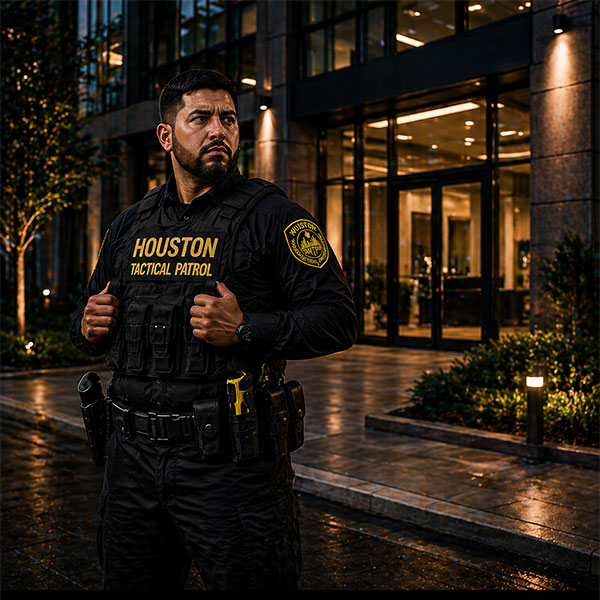
Before choosing a solution, walk the property during the hours when problems are most likely to occur. Look for dark areas, unsecured access points, limited sightlines, recurring complaints, and places where a delayed response would be costly. Houston Tactical Patrol can help translate those observations into a security plan that fits the property instead of forcing the property into a generic package.
The best protection plan is the one your team can rely on at 2:00 a.m., not just the one that looks sufficient on paper.