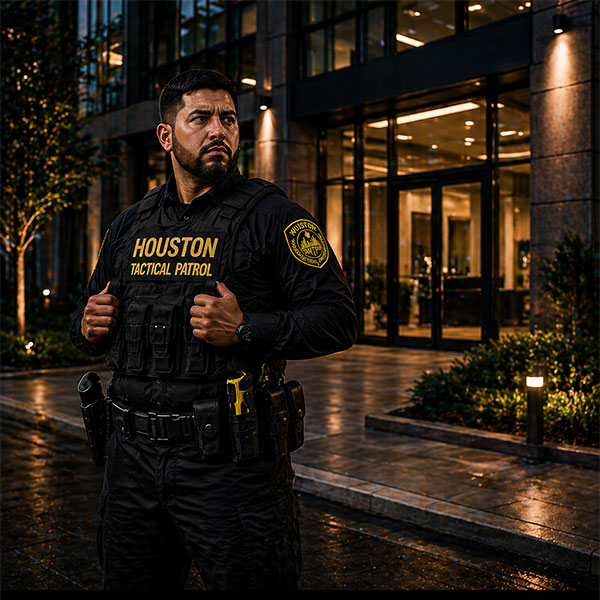
A broken gate, an unsecured loading dock, or an unfamiliar vehicle after closing can become an expensive problem quickly. Commercial security guards give property owners and managers a trained, visible presence that helps prevent incidents before they grow into theft, damage, liability claims, or business interruption.
For many Texas businesses, the decision is not simply whether to hire a guard. It is deciding what kind of coverage will solve the actual risk without creating unnecessary cost or management work. The right security plan accounts for the property, operating hours, traffic patterns, staff responsibilities, and the type of incidents the site is most likely to face.
What Commercial Security Guards Do for a Property
A professional guard is more than someone stationed at a door. Their role is to observe, deter, document, communicate, and respond according to a defined post order. That may mean checking credentials at a construction entrance, walking a retail center after hours, monitoring cameras at a facility, escorting employees to their vehicles, or contacting emergency services when a situation requires it.
Visible coverage changes behavior. Trespassers, vandals, and opportunistic thieves often look for gaps: an unmonitored entrance, poor lighting, a vacant building, or a property where no one appears accountable. A uniformed officer, marked patrol unit, or consistent foot patrol makes those gaps harder to exploit.
The value also extends to legitimate visitors and employees. Staff members are more likely to report concerns when a trained security professional is accessible. Visitors know where to check in. Managers gain a clear point of contact for disturbances, access issues, and incident reporting. That structure matters when a property is busy, spread across multiple buildings, or exposed after normal business hours.
Match Guard Coverage to the Risk
Security is most effective when the assignment fits the environment. A one-size-fits-all schedule may leave critical hours uncovered or pay for a level of staffing the property does not need. Before selecting coverage, evaluate when incidents occur, where unauthorized access is most likely, and how quickly a response is needed.
Fixed-post officers for controlled access
A fixed-post officer is typically assigned to a specific entrance, lobby, gatehouse, loading area, or reception point. This option works well for office buildings, medical facilities, industrial sites, residential communities, and venues where access control is a daily concern.
The officer can verify visitors, manage sign-in procedures, enforce delivery policies, check identification, and watch for suspicious activity at a high-traffic location. A fixed post also provides consistency. Employees and tenants know who is responsible for addressing concerns, while visitors receive a professional first impression.
Patrol services for larger or changing properties
Patrol coverage is often a better fit for properties with multiple vulnerable areas rather than one primary entry point. Shopping centers, parking lots, construction sites, warehouses, apartment communities, and vacant properties may benefit from scheduled or randomized patrols.
A patrol officer can inspect gates, doors, perimeter fencing, common areas, vehicles, and equipment storage. Randomized timing is useful because it makes the security presence less predictable. The trade-off is that a patrol officer is not continuously positioned at one location. If a site needs both active access control and broader property checks, a combined approach may be appropriate.
Armed or unarmed officers
The right choice depends on the site’s risk profile, client policies, local requirements, and the nature of the assignment. Unarmed officers are appropriate for many properties where deterrence, access management, customer service, and observation are the primary needs.
Armed officers may be considered for higher-risk environments, valuable assets, sensitive operations, or locations with a documented threat history. This should never be treated as a default upgrade. Armed coverage requires careful planning, qualified personnel, clear post orders, and a provider that understands the responsibility involved. The goal is measured protection, not an unnecessarily intimidating presence.
The Details That Make Coverage Reliable
Hiring commercial security guards should reduce operational burden, not add another vendor problem to a manager’s day. That starts with a written scope of work that defines exactly what officers are expected to do, when they will do it, and how they will communicate.
Clear post orders should address entry procedures, patrol routes, restricted areas, emergency contacts, reporting expectations, visitor policies, and escalation steps. A guard should not have to guess whether to contact a property manager, call law enforcement, secure an area, or document a recurring issue. Clear direction supports better decisions under pressure.
Supervision is equally important. A dependable security provider verifies that officers arrive on time, understand their assignment, maintain a professional appearance, and follow the established procedures. For a client, that oversight provides accountability without requiring constant calls or on-site management.
Incident reporting turns daily security activity into useful information. Reports should record relevant facts: time, location, people involved, actions taken, witnesses, and any required follow-up. Over time, those records can reveal patterns. Repeated door issues, frequent loitering in one area, or a rise in after-hours activity may show where lighting, fencing, staffing schedules, or access controls need attention.
Questions to Ask Before Hiring a Security Provider
Credentials and pricing matter, but they do not tell the entire story. A strong proposal should show that the provider understands how your property operates and can explain how coverage will be managed.
Ask how officers are selected and trained for the assignment. Experience in a lobby is different from experience on a construction site or at an event. Ask about licensing, insurance, supervisory availability, response protocols, and the process for replacing an officer when coverage changes unexpectedly.
It is also reasonable to ask how the company handles communication. Determine who receives reports, who can adjust coverage, and who answers after-hours calls. Security needs do not always arise during office hours, especially for properties with overnight operations, weekend events, or vacant buildings.
For Houston-area decision-makers, local familiarity can add practical value. A provider that understands the pace of commercial operations, traffic patterns, weather disruptions, and varied property types can organize coverage with fewer surprises. Houston Tactical Patrol LLC provides customized guarding and patrol services designed around those real operating conditions.
Security Works Best as Part of a Larger Plan
Guards are highly effective, but they should not be expected to compensate for every physical weakness on a property. Security cameras, lighting, working locks, access control systems, fencing, alarm procedures, and employee reporting all support a stronger overall posture.
For example, an officer patrolling a poorly lit rear lot may identify suspicious activity, but better lighting can reduce the opportunity for that activity in the first place. A guard at a gate can verify vehicles, but a clear delivery schedule and credential process will make the check faster and more accurate. The strongest plans combine people, procedures, and physical safeguards.
Regular reviews keep the plan aligned with the property’s current risk. A site that begins with overnight patrols may later need daytime access control as tenant traffic increases. A construction project may require more coverage during equipment delivery phases and less after the site is enclosed. Flexible staffing is valuable because security needs rarely stay static.
When Security Coverage Pays for Itself
The cost of a security assignment should be weighed against more than the price of a single theft or vandalism incident. Consider lost operating time, damaged equipment, tenant dissatisfaction, insurance concerns, employee safety, emergency response costs, and the time managers spend handling repeated disturbances.
A visible officer can prevent problems that never appear in a report, which makes the return on security difficult to measure by incidents alone. That does not mean coverage should be vague or open-ended. Set clear objectives, review reports, track recurring issues, and adjust staffing when conditions change.
The best commercial security plan creates confidence without disrupting the people who use the property. Start with the risks that keep your team responding after hours, then build coverage that gives your business a capable, accountable presence where it matters most.