A security provider cannot protect what has not been clearly defined. When a proposal request only says, “We need guards,” vendors are forced to make assumptions about risk, staffing, schedules, and response expectations. That can lead to gaps in coverage, unexpected costs, or personnel who are not prepared for the realities of your property. A detailed security proposal request checklist gives decision-makers a better starting point and makes it easier to compare providers on more than price.
For a business, residential community, construction project, or event, the goal is not simply to hire a visible presence. The goal is to establish dependable coverage that deters unwanted activity, supports tenants and staff, documents incidents, and gives management a clear point of accountability.
Security Proposal Request Checklist: Start With the Risk
Before requesting proposals, identify what is actually happening at the property and when it happens. A retail center dealing with shoplifting and loitering needs a different plan than an apartment community managing vehicle burglaries, access concerns, and resident calls after hours. A construction site may need overnight patrols and equipment checks, while an event may require entry screening, crowd management, and fast coordination with organizers.
Describe recent incidents, recurring concerns, and known weak points. Include theft, trespassing, vandalism, break-ins, unauthorized access, parking problems, disturbances, fire watch requirements, and employee or resident safety concerns. If incidents are concentrated during certain hours or in specific areas, state that clearly.
This information helps a qualified security company recommend the right combination of fixed-post officers, mobile patrols, armed or unarmed coverage, monitoring, access control support, and supervisor oversight. It also prevents an under-scoped proposal that looks affordable until the first incident exposes its limitations.
Define the Property and Coverage Area
A proposal should reflect the physical environment, not a generic staffing package. Provide the property type, address or service area, operating hours, number of buildings, entrances, parking areas, gates, loading zones, common spaces, and any locations that require restricted access.
For larger properties, a site map can be useful, particularly when patrol routes or multiple guard posts are involved. Identify whether officers will work from a lobby desk, gatehouse, leasing office, construction trailer, vehicle, or designated patrol point. If the officer needs access to keys, a gate system, cameras, radios, or visitor logs, include that in the request.
Also explain who will be on site. A warehouse with employees arriving before sunrise presents different concerns than a hospitality property with guests entering at all hours. Security personnel must be able to represent the property professionally while remaining alert to the risks specific to that environment.
Request the Right Type of Security Coverage
A strong request should state the coverage you believe is needed, while allowing qualified providers to recommend adjustments. Be specific about the desired start date, days of service, shift times, and whether coverage must be continuous. If 24/7 protection is required, clarify whether you expect one post, rotating shifts, scheduled patrol checks, or a mix of services.
The core service decision is often between standing guards and patrol units. A standing officer provides a consistent presence at a defined location and can handle access control, visitor checks, observation, and immediate reporting. A marked patrol unit covers a wider area through scheduled or randomized checks and may be a practical option for properties that need visible deterrence without a full-time officer at one post.
Armed and unarmed staffing should be chosen based on the risk level, site conditions, contractual obligations, and local requirements. Armed coverage may be appropriate where there is a credible elevated threat, high-value assets, or a need for enhanced deterrence. It also requires careful vendor evaluation, clear post orders, proper licensing, and an understanding of how officers will respond within the limits of their authority. Unarmed officers are often the right choice for customer-facing environments, access control, routine patrol, and many residential or commercial assignments.
Do not treat armed status as the only measure of security quality. Training, supervision, communication, judgment, reporting discipline, and site familiarity often determine whether an assignment performs as intended.
Specify Duties, Authority, and Boundaries
Every proposal request should define what security officers are expected to do. Common duties include checking doors and gates, monitoring cameras, verifying visitors, controlling access, conducting patrols, documenting incidents, escorting employees or residents, responding to alarms, and contacting law enforcement or emergency services when needed.
Just as important, identify what officers should not be expected to do. Security personnel should not be used as maintenance staff, general customer service employees, or an informal replacement for management. If you expect officers to enforce parking rules, check identification, manage deliveries, or handle resident complaints, describe the process and the authority provided by property management.
Clear post orders protect everyone involved. They help officers act consistently, reduce confusion during an incident, and allow management to measure performance against agreed expectations.
Evaluate Licensing, Training, and Supervision
A low hourly rate does not mean much if the provider cannot staff the account consistently, communicate during an incident, or verify that officers meet Texas requirements. Ask each provider to explain its licensing, insurance coverage, hiring standards, background screening process, training practices, and approach to armed assignments when applicable.
For Texas properties, confirm that the company and assigned personnel are appropriately licensed through the Texas Department of Public Safety. Request proof of insurance and ask whether coverage limits align with your lease obligations, client contracts, or risk-management requirements. A professional proposal should make these items easy to verify.
Staffing reliability deserves equal attention. Ask how the provider handles call-offs, relief officers, shift changes, and emergency coverage. A contract is only useful when the post is staffed as scheduled. For multi-site portfolios or high-risk assignments, ask about field supervisors, after-hours management contacts, quality checks, and escalation procedures.
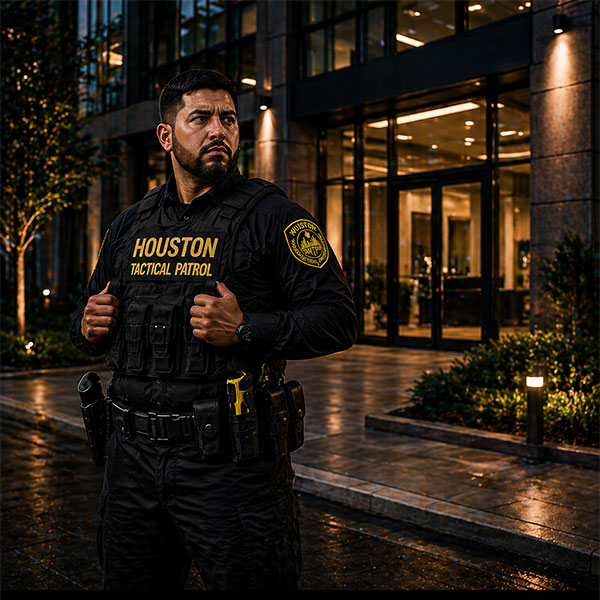
Houston Tactical Patrol LLC approaches coverage with trained personnel, visible deterrence, and around-the-clock operational support. Those standards are especially valuable when a property cannot afford uncertainty after normal business hours.
Require Reporting That Supports Accountability
Security reporting should help management make decisions, not create a stack of unread paperwork. Request examples of daily activity reports, incident reports, patrol logs, and escalation notifications. The format may be digital, written, or both, but the reporting process should be timely, consistent, and easy for authorized managers to review.
Ask what gets reported immediately. Serious incidents such as forced entry, fire hazards, medical emergencies, threats, property damage, or police response should trigger prompt notification to the designated client contact. Routine observations can be included in shift reports, but repeated issues should be elevated before they become a larger loss or liability concern.
If your property has cameras, alarms, gate access records, or a building management platform, ask whether security officers will use those tools and how access will be controlled. Technology can improve awareness, but it does not replace trained personnel who can investigate conditions, make sound observations, and take appropriate action on site.
Compare Proposals Beyond the Hourly Rate
When proposals arrive, compare the scope of service line by line. Confirm the number of hours, officer classification, patrol frequency, vehicle use, holiday coverage, supervisor visits, reporting tools, and any management fees or minimum-hour requirements. Two proposals with similar rates may represent very different levels of service.
Pay attention to exclusions and assumptions. Does the quote include relief coverage? Are patrol vehicles billed separately? Is there an additional charge for special reports, emergency dispatches, equipment, or last-minute schedule changes? Does the provider have a defined process for adding coverage during an incident, evacuation, or high-traffic event?
Price matters, particularly for recurring service, but the lowest bid can become the most expensive choice if it produces turnover, missed shifts, poor documentation, or avoidable incidents. The right proposal should give you a realistic staffing plan, clear expectations, and a provider that can scale when your needs change.
Make the Transition Plan Part of the Request
A new security assignment should not begin with an officer arriving at a property without site instructions. Ask providers how they will conduct the startup process. A disciplined transition includes a site assessment, post orders, client contact list, emergency procedures, access arrangements, reporting expectations, and officer briefing before the first shift.
For an existing contract change, request a plan for maintaining coverage during the handoff. This is especially important for properties with active theft concerns, open access points, resident tension, or ongoing construction activity. The transition should reduce disruption, not create a window of vulnerability.
A well-written request does more than collect quotes. It gives security providers the information needed to recommend coverage that fits the property, budget, and risk level. Take the time to define what protection should look like before service begins, and you will be in a stronger position to hire with confidence and hold the provider accountable once the work is underway.