A broken gate at 2:00 a.m., an unauthorized vehicle behind a retail center, or a delivery driver trying to enter a restricted facility can become a costly problem quickly. The decision between mobile patrol vs static guard determines whether someone is already positioned to manage that moment or must respond after it is discovered.
For property managers, business owners, and event operators, the right answer is rarely about choosing the most visible option alone. It depends on when risks occur, how large the property is, how many access points need attention, and what level of presence your employees, tenants, customers, or guests expect.
Mobile Patrol vs Static Guard: The Core Difference
A mobile patrol officer moves through one or more assigned properties on a scheduled or randomized route. Patrols may check doors and gates, inspect perimeter areas, watch for suspicious activity, respond to alarms, document incidents, and verify that a site is secure after business hours. The officer is visible at intervals rather than stationed in one place for an entire shift.
A static guard is assigned to remain at a specific location. That could be a lobby, construction entrance, gatehouse, loading dock, leasing office, parking garage, or event checkpoint. Their presence provides continual oversight of that post and allows them to manage immediate needs such as visitor screening, access control, credential checks, resident assistance, and incident reporting.
The distinction is straightforward: mobile patrol provides broad coverage across time and distance, while a static guard provides continuous attention at one critical point. Both can deter unwanted activity. They simply address different operational risks.
When Mobile Patrol Is the Better Fit
Mobile patrol is often the practical choice when risk is spread across a property instead of concentrated at a single entrance or facility post. A retail strip center with several vacant suites, for example, may need regular checks of rear doors, dumpster enclosures, parking areas, and utility access points after closing. One officer stationed at the front cannot inspect all of those areas effectively.
This model also works well for properties that do not require constant face-to-face security service. Office parks, warehouses, vehicle lots, self-storage facilities, multifamily communities, and construction sites may benefit from documented patrol visits during higher-risk hours. A marked security unit arriving at varied times can make a property less predictable and less attractive to trespassers, thieves, and vandals.
Cost is another consideration. Since patrol coverage is shared across designated routes or performed at scheduled intervals, it can be more economical than staffing one site continuously. That does not mean it is a lower level of service. It means the service is designed for properties where periodic inspection and response meet the actual security need.
What Mobile Patrol Can Accomplish
A well-managed patrol assignment should be more than a drive-through. Officers need clear post orders, reporting expectations, escalation procedures, and reliable communication with the client or designated contact.
Depending on the assignment, patrol officers can conduct exterior and interior checks, identify unsecured doors or gates, investigate suspicious conditions, respond to alarms, enforce parking rules, monitor common areas, and produce activity reports. For Houston properties exposed to after-hours trespassing, illegal dumping, vehicle burglary, or storm-related access issues, these routine checks can identify problems before they become larger losses.
Mobile patrol has limits. An officer cannot stand at a gate, monitor a lobby, and patrol a perimeter at the same moment. If a property needs continuous access control or immediate in-person assistance throughout the shift, a static guard is usually the stronger option.
When a Static Guard Is the Better Fit
Static coverage makes sense when one location requires constant observation, interaction, or control. A guard at a construction gate can verify authorized workers and vendors before they enter. An officer in a residential lobby can help manage visitors, packages, and resident concerns. At an event, a fixed-position guard can screen entry points and ensure that attendance flows through the proper checkpoint.
This model is particularly valuable where a delay of even a few minutes could create a safety, compliance, or liability concern. Consider a hospital-adjacent facility, a high-traffic apartment complex, a facility with sensitive inventory, or a location receiving frequent deliveries. In these situations, security is not simply checking whether the property is secure. Security is actively managing who enters, what happens at the post, and how issues are handled in real time.
A static officer also becomes a consistent point of contact. Employees and residents know where to find them. Management has someone on-site who understands normal activity, recognizes recurring issues, and can report conditions with useful context. That continuity can be valuable for properties with ongoing operational challenges.
The Staffing Commitment Behind Static Coverage
Continuous coverage requires a larger staffing commitment than periodic patrol. A single 24-hour post requires multiple trained officers to cover shifts, days off, and unexpected absences. The scope of the assignment should account for peak traffic, meal and break coverage, officer qualifications, and whether the post calls for an armed or unarmed presence.
Static guarding is an investment, but it can reduce exposure when the property needs a visible authority figure at all times. The key is matching the post to a clear purpose. A guard who is expected to control access, watch cameras, perform rounds, greet visitors, process deliveries, and manage parking may be asked to do too much at once. Strong security planning defines priorities instead of treating one officer as a solution for every task.
Assess the Risk Before Selecting Coverage
The most effective security program starts with the property’s actual risk pattern. Look at when incidents occur, where they occur, and what happens before they occur. Theft from a rear loading area after midnight requires a different response than unverified visitors entering a corporate office during business hours.
Ask whether the property needs an officer to be immediately available at a fixed point or whether scheduled and randomized checks can address the risk. Consider the number of entrances, visibility across the site, hours of operation, crime history, tenant expectations, asset value, and the consequences of an unauthorized person gaining access.
A few practical scenarios show the difference:
- A gated community with recurring gate malfunctions and visitor disputes may need a static officer during evening traffic, supported by patrol rounds overnight.
- A construction site with valuable equipment and no daytime public access may benefit from overnight mobile patrol checks, especially around the perimeter and equipment storage areas.
- A busy event venue may need static guards at entrances and exits, with mobile officers circulating through parking and crowd areas.
- A multi-site business with several smaller locations may use mobile patrol to maintain visible coverage without placing a full-time guard at every address.
The right service can change by shift. A property may need a static guard during business hours and mobile patrol after closing. Security coverage should follow operational reality, not a one-size-fits-all schedule.
Why a Combined Approach Often Works Best
Many properties are best served by combining both services. Static guards control the areas where people enter, gather, or conduct business. Mobile patrol officers cover parking lots, exterior doors, perimeter lines, secondary buildings, and other areas that a fixed post cannot watch continuously.
This layered approach is especially useful for apartment communities, industrial facilities, larger retail properties, hotels, and special events. It improves visibility without leaving critical access points unattended. It also gives the security team a clearer division of responsibility: one officer manages the post while another investigates conditions across the property.
For example, an apartment community may assign a static officer at the front gate during high-traffic evening hours while a patrol unit checks parking areas, amenity spaces, and building perimeters. At a commercial site, a guard may oversee a loading entrance while patrol officers inspect exterior doors and employee parking areas after hours.
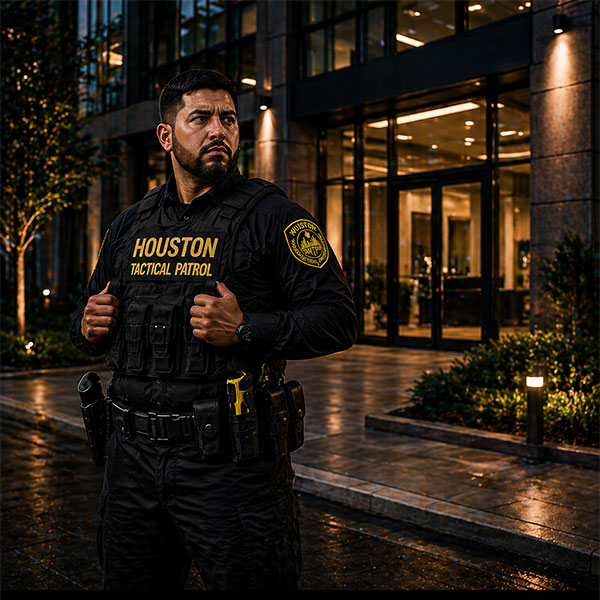
Houston Tactical Patrol LLC can tailor armed or unarmed guard and patrol assignments around those real-world conditions, with clear post orders and accountable reporting. The goal is not to add coverage for its own sake. It is to place trained personnel where their presence has the greatest protective value.
Choose Coverage That Supports Daily Operations
Security should make a property easier to manage, not create another vendor problem for your team. Before approving a service plan, make sure the provider can explain who is responsible for each task, how incidents are reported, when supervisors are involved, and how the assignment can adjust if risks change.
A mobile patrol program is effective when its routes, check points, and reporting are meaningful. A static guard program is effective when the officer has a defined post, appropriate authority, and enough support to remain focused on the priorities that matter. In either case, clear expectations protect the client as much as the physical presence of the officer.
Start with the point where your property is most exposed. Put reliable coverage there, measure what the service finds, and expand or adjust as the risk picture becomes clearer.