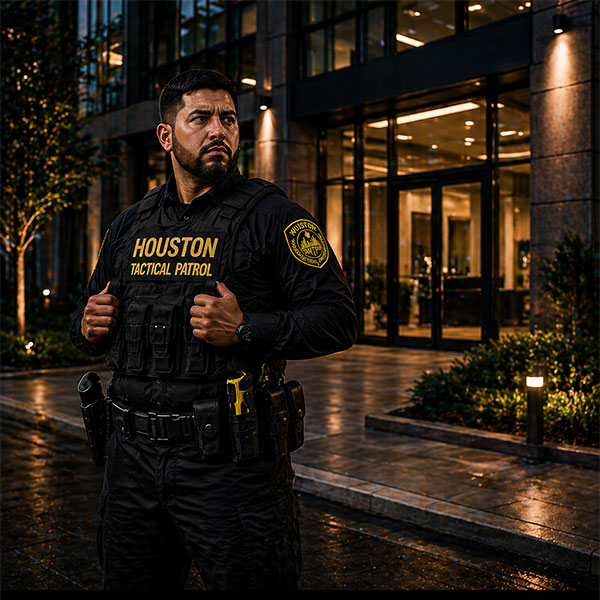
A broken gate at 2:00 a.m., a cash-heavy business closing after dark, a vacant site with repeated trespassing – these are not the moments to guess at your security plan. Armed security protective services are built for situations where visible deterrence, fast response, and professional judgment matter more than a basic presence.
For many property owners and operators, the question is not whether security is needed. The real question is what level of protection fits the risk. Armed coverage can be the right choice for some sites, but not every property benefits from the same approach. The strongest security plans start with a clear look at exposure, public traffic, operating hours, and the consequences of a delayed response.
What armed security protective services actually provide
Armed security protective services do more than place a uniformed officer on site. At their best, they provide trained personnel who can deter criminal activity, monitor access points, identify threats early, document incidents properly, and respond within the limits of the law and site policy.
That distinction matters. Businesses are not just hiring for force capability. They are hiring for judgment, presence, accountability, and professionalism under pressure. A licensed armed officer should know how to de-escalate, when to intervene, how to coordinate with law enforcement, and how to represent a property without creating unnecessary tension.
In practical terms, armed coverage often includes standing guard at fixed posts, access control at entrances, mobile patrols across larger properties, after-hours monitoring, visitor screening, incident reporting, and response to suspicious activity. For some clients, it is also part of a broader security plan that includes unarmed officers, unit patrol, camera monitoring, and event staffing.
When armed security protective services make sense
The right fit usually comes down to risk level. Properties facing repeat theft, vandalism, trespassing, or aggressive confrontations often need more than routine observation. The same goes for locations handling valuable inventory, sensitive information, restricted areas, or late-night operations.
Commercial sites with open public access can be strong candidates, especially when staff members are expected to manage difficult situations they were never trained to handle. Apartment communities may need armed officers if there is a pattern of criminal activity, resident safety concerns, or after-hours disturbances that require more authority and visible deterrence. Construction sites, distribution yards, and equipment storage areas also tend to benefit when losses from theft or intrusion would be costly and disruptive.
Event environments can be more situational. A private event with controlled access may only need unarmed staffing. A large public gathering, high-profile appearance, alcohol service, cash handling, or elevated conflict potential may justify armed support. There is no one-size-fits-all answer. It depends on crowd profile, venue layout, timing, and the consequences if something goes wrong.
Where armed coverage may not be the best first option
Not every property needs an armed officer at the front door. In some settings, that level of security can feel disproportionate to the actual threat and may create the wrong impression for tenants, guests, or customers.
Office buildings with low incident history, daytime-only operations, and controlled entry may be better served by unarmed personnel with strong access control procedures. Retail environments focused on customer comfort may prefer a layered approach, using visible but less intensive coverage unless a specific pattern of risk develops. Residential communities also vary widely. Some need a patrol presence and clear reporting, while others need a more assertive posture.
This is where experience matters. A professional provider should not push armed services simply because they are available. The better approach is to match staffing to the site, the activity level, and the realistic threat picture.
The value goes beyond deterrence
Visible deterrence is often the first reason clients consider armed coverage, and for good reason. A trained, uniformed officer can discourage theft, unauthorized entry, loitering, and opportunistic crime before it starts. That presence alone changes behavior.
But deterrence is only part of the value. Armed officers also create structure. They help control entry points, reinforce site rules, document incidents, support emergency procedures, and provide a reliable point of contact when something feels off. That level of consistency matters to property managers, business owners, and event operators who cannot personally monitor every issue on site.
There is also a reputational benefit when coverage is handled professionally. Staff, tenants, and visitors notice whether security personnel are alert, respectful, and well-managed. A strong officer presence should make people feel safer, not uneasy. That balance comes from training, site preparation, and supervision.
What to look for in a provider
If you are evaluating armed security services, credentials are the starting point, not the finish line. Licensing and legal compliance are essential, but they do not tell you everything about day-to-day performance.
Look for a provider that emphasizes officer training, reporting standards, supervision, and responsiveness. Ask how post orders are developed. Ask how incidents are escalated. Ask what kind of communication you can expect after hours or during emergencies. A dependable company should be able to explain how it staffs shifts, handles call-offs, documents activity, and adapts coverage as risks change.
It also helps to understand the operational mindset of the team. Some vendors are reactive. Others focus on prevention, visibility, and routine discipline. For clients managing commercial properties, communities, events, or multi-site operations, that difference shows up quickly in the quality of service.
Houston Tactical Patrol LLC, for example, positions its services around tailored coverage, licensed personnel, and around-the-clock responsiveness because many clients do not need generic security – they need a team that can step into real operating environments and reduce the burden on management.
Why site-specific planning matters
The same armed officer can perform very differently depending on whether the assignment is clearly defined. Good security planning is not just about posting someone on site. It is about giving that officer the tools, instructions, and authority structure to do the job well.
That includes site orientation, emergency contacts, access procedures, reporting expectations, patrol routes, high-risk zones, and guidance on when management should be notified. For larger properties, patrol frequency and visibility patterns should be deliberate. For customer-facing environments, service expectations should be spelled out so security remains professional and approachable.
This is one reason customized service matters. A warehouse, a hotel, a gated community, and a special event all have different pressure points. Effective armed protection reflects those differences instead of flattening them into a standard post.
Cost, liability, and the reality of trade-offs
Armed security is a higher-level service, and that usually means higher cost. For some clients, the expense is clearly justified by loss prevention, reduced liability exposure, or the nature of the site. For others, it may be more practical to combine unarmed staffing, mobile patrol, lighting improvements, camera coverage, and stricter access control.
There is also a responsibility component. Armed officers should never be treated as a shortcut for poor site management. If gates do not work, keys are uncontrolled, lighting is weak, and visitor procedures are inconsistent, security staffing alone will not solve the underlying problem. The best outcomes come from pairing trained personnel with solid property procedures.
Decision-makers should also consider perception. In some environments, armed coverage sends the right message – serious, prepared, protective. In others, a softer but still highly disciplined approach may be more effective. That balance should be discussed openly during planning instead of decided after an incident forces the issue.
A better way to think about protection
The smartest reason to hire armed security is not fear. It is clarity. You know your property has meaningful risk, you know the cost of inaction, and you want trained professionals who can deter problems and respond with discipline.
That is what armed security protective services are meant to do when they are staffed correctly and managed well. Not to overcomplicate your operation, and not to create a show of force for its own sake, but to close serious security gaps with visible, accountable protection.
If your site has already shown you where the weak points are, it is worth paying attention. Security works best when it is put in place before the next incident tests it.