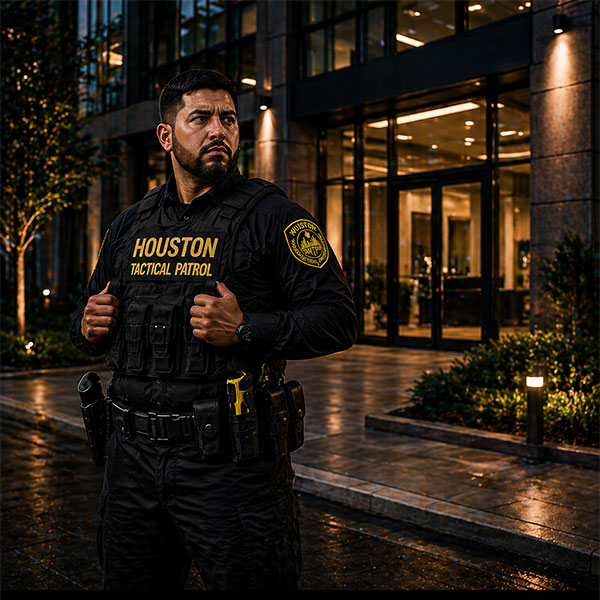
A camera may record a break-in clearly enough to identify what happened. It cannot challenge a trespasser, inspect a damaged gate, escort an unauthorized person off-site, or make a judgment call when a situation begins to escalate. That is the practical difference property decision-makers must weigh when comparing patrol guards versus cameras.
For businesses, communities, job sites, and events, the right answer is rarely about choosing the most technology or the most personnel. It is about matching the protection plan to the risks on the property, the hours those risks occur, and the response your operation needs when something goes wrong.
Patrol Guards Versus Cameras: The Core Difference
Cameras are observation tools. They document activity, support investigations, and can alert a monitoring team to motion or other defined events. Their value is substantial, particularly at entrances, parking areas, loading zones, common spaces, and locations that need a reliable visual record.
Patrol guards are active security personnel. A trained officer can observe conditions as they develop, perform scheduled or randomized patrols, address access-control concerns, report hazards, contact law enforcement or emergency services, and respond according to site procedures. A marked patrol presence can also change behavior before an incident occurs.
That distinction matters. A camera answers, “What happened?” A patrol officer is positioned to address, “What is happening now, and what needs to happen next?”
Neither option eliminates risk. Cameras can have blind spots, poor angles, connectivity failures, or footage that is not reviewed until well after an event. Guard coverage depends on clear post orders, proper staffing, communication, supervision, and personnel who understand the assignment. Security planning works best when these limitations are acknowledged early rather than discovered after a loss.
Where Cameras Deliver Strong Value
Cameras are often an efficient foundation for broad visual coverage. A well-designed system can watch multiple fixed areas around the clock without placing an officer at every entrance or corner of a large property. For a manager responsible for several sites, that visibility can make it easier to review activity and investigate recurring issues.
They are especially useful when the primary need is documentation. A retail center may need footage of vehicle damage in a parking lot. A warehouse may need to review dock activity. A residential community may want to monitor entrances, package areas, or amenities. In these cases, clear camera placement, lighting, retention policies, and regular equipment checks are as important as the cameras themselves.
Remote monitoring can make cameras more proactive, but it still has limits. A monitoring operator must receive a usable alert, assess what is on screen, decide whether the activity is suspicious, and coordinate a response. There can be delays, and the operator cannot physically inspect an open door or separate a dispute on the property.
Cameras also send a visible message that a site takes security seriously. But experienced offenders may test sightlines, conceal their identity, approach from unmonitored areas, or assume nobody is actively watching. Recording evidence is valuable. It is not the same as having a capable person present.
When Patrol Guards Are the Better Fit
Patrol service is often the stronger choice when a property needs visible deterrence and active response rather than surveillance alone. A marked unit moving through a site, checking vulnerable areas, and varying patrol times is harder to predict and harder to ignore than a fixed camera on a wall.
This is particularly relevant for after-hours commercial properties, construction sites, vacant buildings, multifamily communities, retail centers, and facilities with repeated trespassing or theft concerns. These environments may involve unsecured doors, loitering, attempted vehicle entry, unauthorized access, suspicious activity, or safety issues that need an immediate on-site assessment.
A professional patrol officer can do more than watch. They can inspect perimeter conditions, verify that gates and doors are secured, document incidents, respond to alarms, enforce property rules within their authority, and notify the appropriate contacts. At a residential community or hospitality property, they can also provide a calm, professional point of contact for residents, guests, staff, and vendors.
The human factor is central. Security personnel can recognize context that a camera may not capture: a contractor who should not be on-site after hours, a delivery vehicle in the wrong area, a damaged fence that creates a new access point, or a verbal conflict that could become a larger problem. Good officers do not replace law enforcement. They help manage a situation professionally, preserve information, and call for additional assistance when needed.
Cost Should Be Measured Against the Risk
Cameras generally require an upfront investment in equipment, installation, storage, networking, and maintenance. Their ongoing costs can be manageable, but a low-cost system that delivers unclear footage or fails during an incident can create false confidence.
Patrol guards involve recurring service costs because trained personnel, supervision, dispatch capability, vehicles, reporting, and coverage management are part of the service. For some properties, a full-time stationed officer is appropriate. For others, scheduled or randomized vehicle patrols provide better value by placing a visible security presence at key risk periods without staffing every hour.
The more useful question is not simply, “Which costs less?” It is, “What would one serious incident cost this operation?” Consider loss of inventory, property damage, downtime, resident or tenant dissatisfaction, employee safety, insurance claims, and potential liability. A security plan should be proportionate to the exposure, not built around the lowest line item.
For example, a small office building with limited after-hours activity may be well served by cameras, lighting improvements, and periodic patrol checks. A construction project with valuable equipment and an open perimeter may require frequent mobile patrols, camera coverage, and documented site inspections. The answer changes with the property.
The Strongest Plan Often Uses Both
The most dependable security programs combine cameras and patrol coverage in a way that gives each tool a clear job. Cameras extend visibility. Patrol officers provide presence, inspection, judgment, and response. Together, they create a more complete picture of activity on the property.
A camera alert can direct an officer toward a specific area. An officer can then assess the scene in person, determine whether there is an actual threat, document conditions, and escalate appropriately. Patrol reports can also reveal patterns that help improve camera placement, lighting, fencing, access procedures, and patrol schedules.
This approach is valuable across multi-location operations. Rather than applying the same coverage everywhere, a company can use cameras for consistent oversight and place patrol resources where incidents, traffic, operating hours, or asset values justify a stronger physical presence.
Questions to Ask Before Choosing Coverage
Before committing to guards, cameras, or a combined plan, start with the incidents you are trying to prevent. Theft, trespassing, vandalism, parking-lot concerns, unauthorized access, and fire watch needs each call for different measures. Review when incidents occur, where they occur, how quickly someone must respond, and whether the property needs a visible deterrent.
Also consider what happens after an alert. Who sees it? Who verifies it? Who contacts police, emergency services, management, or maintenance? If no one owns the response process, even an advanced camera system may only provide a record after the fact.
For guard coverage, ask how patrol routes are designed, how activity is documented, how officers communicate with management, and how the provider handles missed check-ins or urgent calls. A security vendor should be able to explain the assignment in practical terms, including the expected responsibilities and reporting process.
For cameras, ask whether coverage includes the areas that matter most, whether lighting supports usable footage, how long recordings are retained, and whether the system is monitored or simply recording. Security gaps often come from operational details, not from the absence of equipment.
Houston Tactical Patrol LLC helps clients build coverage around real property conditions rather than a one-size-fits-all security package. Whether the need is vehicle patrol, staffed officers, event coverage, or a coordinated approach with existing camera systems, the goal is clear: dependable protection that does not create more work for management.
The best next step is a site-specific risk review. Walk the property after hours, look at entry points from an intruder’s perspective, identify where response time matters most, and build coverage around those realities. A security plan earns its value when it helps prevent the problem you hoped you would never have to explain.