A security issue at one property can quickly become a management problem across every property. A break-in at an unattended warehouse, repeated trespassing at a shopping center, or an access-control gap at an apartment community does more than create a single incident report. It raises questions about staffing, response, supervision, and whether the same weakness exists elsewhere. Effective multi site security management gives owners and operators one accountable structure for protecting different locations without treating every site like an unrelated contract.
For organizations with several facilities, the goal is not to make every property look identical. The goal is to establish consistent protection standards while giving each location the coverage it actually needs. That balance reduces risk, simplifies oversight, and gives decision-makers a clearer view of what is happening after hours.
Why Multi Site Security Management Requires a Different Approach
Managing security at one location is already a daily operational responsibility. Managing it across offices, construction sites, retail properties, industrial yards, residential communities, or event venues adds layers of complexity. Each site may have different hours, traffic patterns, access points, crime concerns, tenant expectations, and emergency procedures.
The common mistake is assigning guards site by site with no central plan. That can create uneven coverage, inconsistent reporting, and uncertainty over who is responsible when a post is uncovered or an incident needs escalation. A property manager may receive detailed patrol reports from one location and little visibility from another. Leadership is then left trying to compare incomplete information when making staffing or budget decisions.
A managed program should provide a single operating standard for personnel, reporting, supervision, and communication. At the same time, it must account for what makes a site vulnerable. A vacant commercial building may need frequent vehicle patrols and perimeter checks. A busy residential property may need a visible officer at the entry point during peak evening hours. A distribution yard may require strict gate control, trailer checks, and overnight patrols.
Consistency should apply to accountability, not to a one-size-fits-all schedule.
Start With a Site-by-Site Risk Assessment
Before setting posts or patrol routes, document the conditions at every location. This is where a security program moves beyond simply placing a uniformed officer on a property. The assessment should identify the practical issues that create exposure: poorly lit areas, unsecured gates, recurring theft, unauthorized parking, employee safety concerns, high-value equipment, isolated work areas, or a history of after-hours calls.
It also helps to consider how the site operates. A retail location may face its greatest loss-prevention risk during business hours, while a construction site is most exposed overnight and on weekends. A corporate office may need visitor screening during the day but only periodic exterior patrols after closing. The right coverage follows the risk, not a generic staffing model.
Property leaders should also identify which risks are shared across the portfolio. If multiple sites have catalytic converter theft, copper theft, vandalism, or unauthorized entry issues, the security provider can apply lessons from one location to the others. That creates faster adjustments and more informed patrol strategies.
Build One Standard, Then Tailor the Posts
A central security plan should define the non-negotiables for every location. Officers need clear expectations for professional appearance, post arrival, radio or phone communication, report writing, incident escalation, and interaction with tenants, visitors, employees, and law enforcement. These standards protect the client’s reputation as much as the physical property.
From there, each post order should explain the assignment in plain terms. Officers need to know where to patrol, which doors or gates to inspect, who may enter restricted areas, how to handle suspicious activity, and when to contact a supervisor, emergency services, or the client representative. Vague instructions lead to vague performance.
The strongest post orders also account for site-specific realities. A guard at a medical office building should not use the same response process as an officer assigned to an active construction site. One may be focused on visitor conduct and after-hours access. The other may need to monitor equipment, contractor activity, delivery vehicles, and changing perimeter conditions.
This is also where armed and unarmed coverage should be evaluated carefully. Armed officers may be appropriate for higher-risk assignments, valuable assets, or locations where the client needs a heightened security presence. Unarmed guards and patrol officers can be highly effective for access control, deterrence, observation, reporting, and customer-facing posts. The appropriate choice depends on the site, the threat profile, and the responsibilities assigned to the officer.
Visibility, Supervision, and Reporting Must Work Together
A visible security presence can discourage trespassing, theft, and other unwanted activity. But visibility alone is not management. A multi-location program needs supervision that confirms officers are performing assigned duties, follows up on incidents, and corrects issues before they become recurring failures.
Regular supervisor checks matter because conditions change. A gate that was secure last month may be left open after a contractor changes the worksite layout. A new tenant may create increased evening traffic. A patrol route may need adjustment after a theft attempt reveals a blind spot. Field supervision provides the operational awareness that a static schedule cannot.
Reporting is equally important. Clear daily activity reports, patrol records, incident reports, and escalation notes give management evidence of coverage and a record of conditions at the property. Reports should be useful, not paperwork for its own sake. A good report tells the client what occurred, where it occurred, what action the officer took, whether outside assistance was called, and what follow-up is recommended.
Across multiple sites, standardized reporting makes patterns easier to spot. If several locations report damaged fencing, unauthorized vehicles, or repeated access issues, the client can address a larger operational problem rather than reacting to each report in isolation.
Plan for Coverage Gaps Before They Happen
Security programs often fail at the least convenient time: a scheduled officer calls out, a severe weather event disrupts travel, an incident requires additional personnel, or a property suddenly needs overnight fire watch. For multi-site clients, one coverage failure can force internal staff to scramble while other locations remain exposed.
A dependable provider plans for relief staffing, supervisor support, and emergency communications in advance. The client should know who receives after-hours calls, how an uncovered post is escalated, and what response can be expected when conditions change. Around-the-clock availability is especially valuable for properties with overnight operations, vacant buildings, or repeated after-hours concerns.
There are trade-offs. A fully staffed fixed post provides the greatest consistency and visibility, but it costs more than scheduled mobile patrols. Mobile patrol can cover several properties efficiently and provide an unpredictable presence, but it is not a substitute for a dedicated officer where immediate, continuous access control is required. Many portfolios benefit from a combination: fixed guards at higher-risk locations and patrol units supporting lower-traffic or after-hours sites.
Keep Communication Simple for the Client
The right security partner should reduce administrative burden, not add another layer of coordination. Multi-location clients benefit from a defined point of contact, clear escalation paths, regular performance discussions, and the ability to adjust coverage as business conditions change.
That does not mean every question must go through one person before action can be taken. Officers and supervisors need authority to respond appropriately to urgent situations within established procedures. The client, however, should not need to chase separate contacts at each site to understand what happened overnight.
A disciplined communication structure also helps when ownership groups, regional managers, property managers, and onsite teams all have different responsibilities. Set expectations early about who receives routine reports, who is contacted for urgent incidents, and who can authorize changes to the assignment. This prevents delayed decisions when a security concern needs immediate attention.
Choose a Provider Built for Operational Accountability
When evaluating a security provider for multiple locations, licensing, training, staffing depth, and supervision deserve more attention than a low hourly rate alone. A lower-cost proposal can become expensive if guards arrive late, posts go uncovered, reports lack detail, or the provider cannot scale during a problem.
Ask practical questions. How are officers selected for different assignments? Who performs field supervision? What does incident reporting look like? How are call-outs handled? Can the provider add patrols, event coverage, fire watch, or additional officers when circumstances change? The answers reveal whether the company is prepared to manage an ongoing program rather than merely fill shifts.
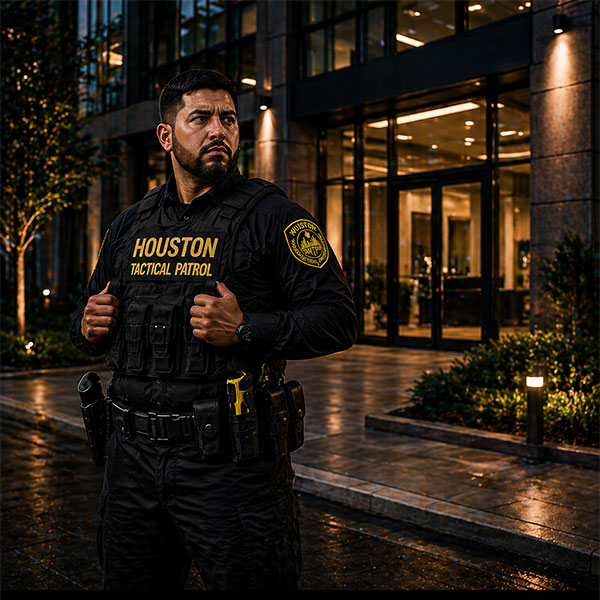
For Texas properties, Houston Tactical Patrol LLC can tailor staffed guard and patrol coverage around the risks, operating hours, and service expectations at each location. The objective is straightforward: professional personnel, visible deterrence, clear communication, and dependable support when conditions require action.
The best multi-site program gives every property a security plan that fits while giving leadership one reliable standard of accountability. When a concern appears at any location, the response should be organized, documented, and ready to improve the protection of the entire portfolio.