A break-in alarm goes off at 2:00 a.m. A trespasser is walking a construction site. An employee reports a fight at an event entrance. In each situation, the question is not simply whether to call 911. The practical question in security guards versus police is who is responsible for the immediate situation, who has legal authority, and who can stay focused on your property after the initial incident ends.
Police and private security serve different but complementary roles. A law enforcement agency protects the public, investigates crimes, and enforces the law across its jurisdiction. A security provider protects the specific people, property, operations, and access points covered by a client agreement. Property managers and business owners get better results when they understand where those responsibilities meet and where they remain separate.
Security Guards Versus Police: The Core Difference
Police officers are government law enforcement professionals with broad public authority granted by state and local law. Their duties include responding to emergency calls, investigating criminal activity, making arrests when legally justified, preserving evidence, and working cases through the criminal justice system.
Security guards are private professionals hired to provide a defined protective presence at a specific property, event, facility, or group of locations. Their assignment may include access control, visitor screening, patrols, camera monitoring, incident reporting, parking enforcement on private property, fire watch, and direct observation of suspicious behavior.
That distinction matters when setting expectations. A guard is not a replacement for a police department, and police cannot provide a dedicated, continuous presence at every private location that has recurring risk. A trained guard can identify a problem early, discourage it from escalating, communicate with emergency services, and protect the scene until law enforcement arrives when needed.
For many properties, the strongest approach is not choosing one over the other. It is building a security plan that uses private security for prevention, continuity, and site control, while relying on police for active crimes, emergencies, investigations, and situations requiring law enforcement authority.
Authority and Responsibilities Are Not the Same
A common mistake is assuming that an armed security officer has the same authority as a police officer. That is not generally the case. Private security personnel in Texas operate within the limits of state law, their licensing, their training, and the client’s property rules. Their authority is more limited and assignment-specific than that of sworn law enforcement.
Security officers can enforce reasonable site policies, such as checking credentials, directing visitors, controlling entry into restricted areas, and asking unauthorized people to leave private property. They may observe, document, report, and, under appropriate legal circumstances, take action available to private citizens. However, they do not conduct criminal investigations or exercise general police powers simply because they are in uniform.
Police officers, on the other hand, may investigate alleged offenses, issue citations where authorized, make arrests based on applicable legal standards, and access law enforcement systems and procedures unavailable to private guards.
This difference should shape your post orders. A guard’s role should be clear: monitor designated areas, enforce site procedures, contact management, document activity accurately, and escalate threats through the proper chain. Clear instructions reduce confusion in a stressful moment and help security personnel represent your property professionally.
Response Time Depends on the Type of Coverage
When an emergency occurs, police response is influenced by call volume, available units, severity, and public safety priorities. A life-threatening emergency will receive urgent attention. A delayed report of vandalism, trespassing, or suspicious activity may wait longer, especially during periods of high demand.
A dedicated guard is already at the property or assigned to patrol it. That changes the first few minutes of an incident. Visible security may spot an unlocked gate before a trespasser enters, question unfamiliar activity before theft occurs, or call for police with specific details rather than a general report from a remote camera alert.
This does not mean a guard should confront every situation. Sound judgment is part of professional security work. If there is an immediate threat, a weapon, violence, or an active crime, the priority is protecting people, requesting law enforcement and medical assistance, and avoiding unnecessary escalation. A guard’s proximity gives your team immediate eyes and communication. Police provide the public safety response and investigative authority when the incident demands it.
Prevention Is Often the Value of Private Security
Police are essential after a crime, during an emergency, or when a legal enforcement response is necessary. Yet most businesses would prefer to prevent the incident that creates the 911 call in the first place.
A uniformed officer at a retail center makes shoplifting, loitering, and unauthorized after-hours access less attractive. A patrol unit at an apartment community can identify broken perimeter gates, unsecured amenity areas, or suspicious vehicles. At a construction site, regular checks can reveal equipment exposure, fence breaches, or signs of attempted theft before losses grow. Event security can manage lines, credential checks, bag policies, and crowd flow before an argument turns into a disruption.
That ongoing presence is difficult for a public law enforcement agency to provide at one privately owned location. It is precisely what a customized guard or patrol program is designed to deliver.
The right coverage depends on your risk. A corporate office may need a professional lobby officer during business hours. A warehouse may need overnight vehicle patrols and gate checks. A residential community may benefit from marked patrol visibility at changing hours. A high-risk location or sensitive assignment may require armed personnel, but armed coverage should be selected based on a real assessment of threat, duties, training requirements, and site conditions, not simply because it appears more forceful.
Cost Is More Than an Hourly Rate
Police services are funded by taxpayers, but a business cannot ordinarily reserve on-demand officer coverage for routine private property needs without using an approved off-duty program where one is available. Even then, the assignment structure, availability, cost, and permitted duties can differ from a private security contract.
Private security is a direct operating expense. In return, the client has greater control over scheduling, location coverage, uniform standards, reporting expectations, patrol routes, and post instructions. A dependable provider can also scale coverage for seasonal traffic, special events, construction phases, tenant changes, or a temporary increase in risk.
The lowest guard rate is not always the lowest-cost decision. Poorly trained or poorly supervised coverage can create reporting gaps, inconsistent attendance, weak customer interaction, and unnecessary liability. Ask what training, licensing, supervision, incident documentation, communication procedures, and replacement coverage are included. Those details determine whether you are paying for a person in a uniform or for an accountable security operation.
When to Call Police Immediately
Private security should escalate to law enforcement without delay when there is an active threat to life or safety, a violent disturbance, a weapon, a serious medical emergency, a fire, suspected criminal activity requiring police intervention, or a situation that cannot be safely managed under site procedures.
Your staff should also understand that calling police is not a failure of the security plan. It is the correct response when the incident crosses into public safety or criminal enforcement. Guards can meet responding officers, provide a concise account of what occurred, identify witnesses, preserve relevant observations, and help keep uninvolved people away from the scene.
For non-emergency concerns, a guard may handle the matter through established property rules. That could mean documenting a parking violation, requesting that an unauthorized visitor leave, notifying management about a maintenance concern, or recording a recurring access-control issue for follow-up. The response should always match the facts and the level of risk.
Building a Plan That Supports Law Enforcement
The best security programs make police response more effective when it is needed. They do this by maintaining current site information, defining who can authorize access after hours, documenting incidents promptly, and establishing a clear escalation process for guards, managers, and employees.
Your security provider should understand the layout of the property, critical assets, emergency exits, camera locations, keyholders, tenant concerns, and known risk patterns. A patrol that only drives through a lot without checking vulnerable areas may look visible but miss the operational purpose of security.
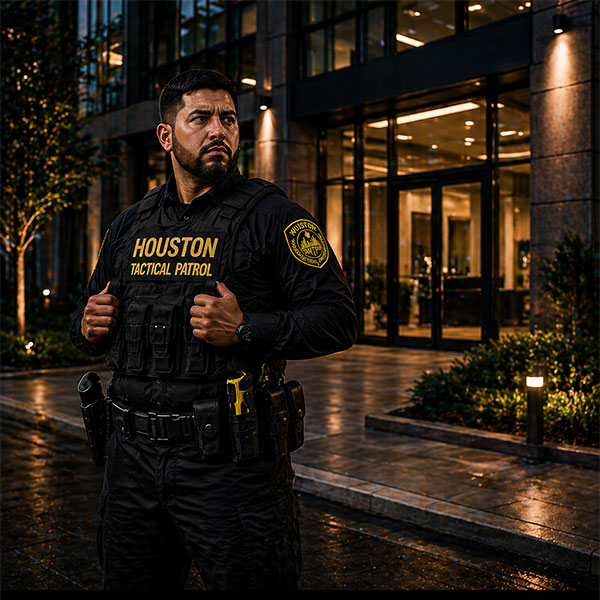
For Houston-area businesses, communities, and event operators, Houston Tactical Patrol can tailor guard and patrol coverage around the actual conditions of the site. The goal is straightforward: maintain a professional presence, identify problems early, and ensure that law enforcement is contacted quickly and provided useful information when an incident requires their involvement.
Security guards versus police is not a competition over who does more. It is a decision about assigning the right responsibility to the right resource. When your property has consistent coverage, clear procedures, and a trained team prepared to escalate appropriately, you give your people a safer, more orderly place to work, live, visit, and do business.