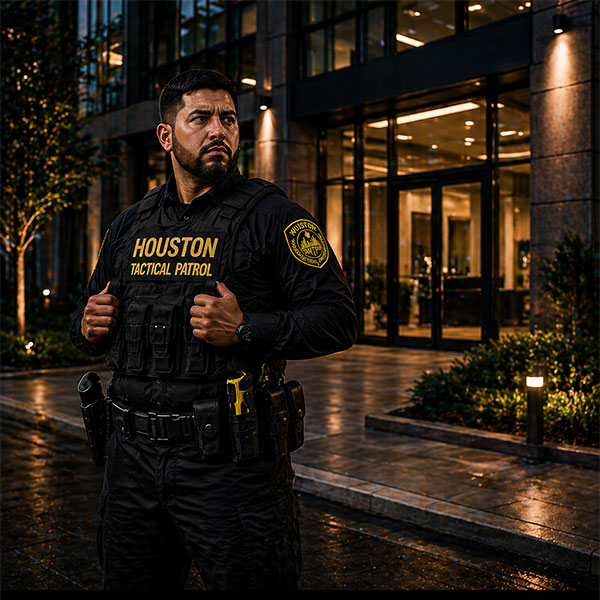
A break-in at a closed construction site and an access-control issue at a busy apartment community may both require security, but they do not necessarily require the same type of officer. The armed guards vs unarmed decision should begin with the actual risks on your property, not with a one-size-fits-all assumption about what looks strongest or costs least.
The right security presence protects people, property, and operations while fitting the environment your tenants, customers, employees, or guests encounter every day. For some sites, a visible unarmed officer provides the professional oversight needed to stop problems before they grow. For others, the risk profile calls for an armed officer with the training and authority to respond to more serious threats.
Armed Guards vs Unarmed Security: The Core Difference
Both armed and unarmed security officers can provide visible deterrence, conduct patrols, monitor access points, document incidents, enforce site rules, and contact law enforcement or emergency services when needed. The difference is not whether one role is “real” security. It is the level of force available, the training requirements involved, and the type of environment each assignment is designed to support.
An armed officer carries a firearm while on duty and must meet the applicable Texas licensing and qualification requirements. This option is often appropriate where there is a credible concern about violent crime, high-value assets, isolated overnight operations, or a history of threatening confrontations.
An unarmed officer does not carry a firearm but remains an active security presence. Unarmed coverage is commonly used for access control, visitor management, foot patrols, concierge-style security, parking enforcement, fire watch, event entry, and routine property patrols. A trained unarmed officer can still identify suspicious activity, de-escalate conflict, preserve evidence, report concerns, and coordinate a prompt response.
The best choice depends on the assignment. Carrying a firearm does not automatically make an officer better suited to every property, just as unarmed coverage is not automatically the lower-quality option.
When Armed Guard Coverage Makes Sense
Armed security is generally considered when the potential consequences of a threat are high. A property manager may need armed coverage after repeated burglaries or credible threats against staff. A business handling expensive equipment, sensitive materials, cash, or controlled access areas may need a higher level of deterrence. An overnight facility in a remote area can also present risks that differ sharply from a daytime office environment.
Common situations where armed officers may be appropriate include high-risk construction sites, vacant properties with recurring trespass activity, certain industrial operations, financial transactions, high-value retail, and facilities with a documented history of violent incidents. Armed coverage may also be suitable for events where the threat assessment, crowd profile, venue layout, or public visibility creates elevated concerns.
That said, armed security should be assigned carefully. The presence of a firearm changes the stakes of every encounter. It requires clear post orders, a defined chain of communication, appropriate supervision, and officers who understand both the client’s expectations and the legal limits of their role. Professional armed officers are not there to escalate routine disputes. Their value is disciplined judgment, deterrence, observation, and readiness when a serious threat emerges.
For many clients, the strongest benefit is visible deterrence. Criminals often look for easy opportunities. A professional, clearly identified armed officer can make a site less attractive to someone considering theft, vandalism, or unauthorized entry.
When Unarmed Guards Are the Better Fit
Unarmed security is often the right solution when the primary goal is prevention, oversight, customer-facing professionalism, or consistent rule enforcement. A well-positioned officer at a lobby desk, gatehouse, loading area, or event entrance can prevent unauthorized access before it becomes a larger issue.
Residential communities frequently use unarmed officers for gate access, amenity monitoring, parking patrols, package-area checks, and resident assistance. Commercial properties may use them to monitor entrances, escort vendors, secure common areas, and identify after-hours activity. Hospitality and event environments may favor unarmed officers because they can maintain a welcoming, service-oriented presence while still managing entry points and addressing disruptive behavior.
Unarmed coverage can also be an effective choice for locations where a firearm could make customers, residents, or employees uncomfortable. The goal is not to appear less secure. It is to match the security posture to the setting. An officer who communicates clearly, stays visible, writes accurate reports, and follows site procedures can deliver meaningful protection without creating an unnecessarily aggressive atmosphere.
This option is also valuable when security needs are broad but not high-threat. Routine patrols, fire watch, access control, parking management, and policy enforcement all benefit from trained personnel who remain alert and accountable throughout the shift.
Evaluate the Risk Before Choosing a Guard Type
A decision should be based on a practical site assessment, not only on a recent incident or a competitor’s security plan. Start by examining what happens at the property, when it happens, and where the vulnerabilities are.
Consider the property’s hours of operation, traffic patterns, location, lighting, access points, asset value, crime history, and prior incidents. Review whether employees work alone, whether the site is vacant overnight, and whether the public can move freely through the space. A single unmonitored delivery entrance may matter more than a large, well-lit front lobby with controlled access.
Also consider the nature of likely incidents. Is the main concern package theft, unauthorized parking, loitering, vandalism, employee safety, trespassing, or violent confrontation? These risks require different responses. A property experiencing repeated vehicle break-ins may benefit from scheduled or randomized patrols, better reporting, and visible officer presence. A site with credible threats or high-value assets may require armed coverage as part of a larger protective plan.
Past incidents deserve attention, but they should not be the only factor. A calm property can still have exposure because of its location, operating hours, layout, or lack of access control. Conversely, one isolated event does not always justify a permanent armed post.
Budget, Liability, and Public Perception Matter
Cost is a legitimate part of the armed guards vs unarmed comparison. Armed officers typically cost more because of the qualifications, training, insurance considerations, and responsibility associated with the assignment. But choosing solely on hourly rate can create gaps that cost more later through losses, property damage, tenant dissatisfaction, or operational disruption.
The more useful question is whether the coverage produces the outcome the site needs. A well-designed unarmed patrol program may reduce incidents at a multi-family property more effectively than an armed officer stationed in the wrong area at the wrong time. Likewise, a high-risk site may be underprotected if it relies on unarmed staffing when credible threats indicate a need for a stronger posture.
Public perception should be considered honestly. Armed officers can reassure employees and tenants at a site with known security challenges. In other environments, such as a family-oriented event, medical office, luxury residential community, or customer-facing retail space, a polished unarmed officer may better support the experience you want to create.
Clear communication helps. Let officers know whether their role is primarily access control, customer assistance, patrol, incident response, or all of the above. Let staff and tenants know how to report concerns. Security works best when expectations are understood before an incident occurs.
Build a Security Plan Instead of Buying a Label
Many properties do not need to choose one approach forever. Security needs can change by shift, season, construction phase, event schedule, or incident trend. A site may use unarmed officers during public-facing business hours and armed coverage overnight. Another may use an unarmed officer at the front entrance, paired with mobile patrols after hours.
Layered protection often produces better results than relying on a single measure. Cameras, lighting, access controls, alarm response procedures, signage, patrol documentation, and trained officers should support one another. Security personnel are most effective when they have clear post orders, working communication tools, and a management team that acts on reports.
Houston Tactical Patrol LLC develops staffing plans around the site, the risk, and the client’s operating needs. That means looking beyond the title of the officer and focusing on dependable coverage, professional conduct, and a response plan that makes sense for the property.
The right guard assignment should make your operation feel more controlled, not more complicated. Start with the risks your people face after hours, at entry points, and during daily activity, then select the level of coverage that gives your property a credible, professional security presence.